
OCTOBER – There is a time
In Sacred Gardens: A Guide to the Traditions, Meaning and Design of Beautiful and Tranquil Places, Martin Palmer & David Manning observe that “In recent years churchyards are beginning to take on a new dimension – one of trying to welcome their visitors into a burial ground which is managed just as much for life as it is for death”. They continue “The basic theme in Christian gardening is a celebration of the wonders of creation”.
Possibly the most famous Christian gardens are monastic, with their ordered beds of herbal and medicinal plants surrounded by paved paths on which monks would walk, pray and meditate. The space for reflection has been carried on down the centuries as part of our ‘sacred places’.
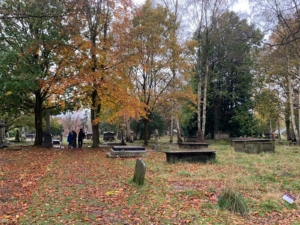
In our own sacred space in St Mary’s churchyard we will soon be surrounded by the autumnal colours of a season possibly overlooked in favour of the glory of spring and the burst of abundant colours in summer. Yet, as a recent commentator on ‘Thought for the Day’ on Radio 4 expressed it, “Perhaps we should give thanks for what autumn gives to us; a chance to pause and look at the wonders of creation”. We need to perceive more closely what is under our feet, as FOBCY reported last week of the many types of fungi which are popping up in the leaf litter. We can marvel at the brilliant colours of the trees with their autumnal foliage before the leaves fall to the ground. We can look to compost heaps to enrich the soil for further growth in following years. As the Radio 4 broadcaster concluded, quoting from Ecclesiastes: “There is a time for everything under the sun”.
Vivienne Plummer
(Image by Christine Weekes).
SEPTEMBER – All nature as the mirror of God
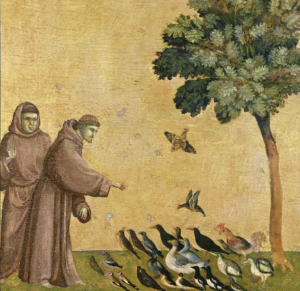
St Francis of Assisi
Allowing nature to thrive and providing a home for wildlife is one of the core aims of FOBCY – an aim which Giovanni di Petro di Bernadone (1181-1226) would have endorsed, with his deep concern for the natural world and the welfare of animals in his poems and prayers. His is an unfamiliar name to most — and he is much better known as St Francis of Assisi, patron saint of ecology, animals and gardeners, who was canonized in 1228 and whose feast day is 4th October. Francis considered ‘All nature as the mirror of God’, calling all creatures his ‘brothers and sisters’
In her recent notes Joanna has mentioned how FOBCY follow the dictates of the weather and seasons – allowing some spaces to be kept; for ecological reasons whilst other parts though mown or cut down are left aside for food for birds and for self-seeding.
On 6th September and 4th October FOBCY invite us to join them in an autumnal tidy up of St Mary’s churchyard complying with their core aim of ‘Allowing Nature to thrive and providing a home for wildlife’.
Whilst St Francis has many flowers associated with him, perhaps the wild plants and flowers are of the most importance. They attract wildlife and birds into our gardens and our churchyard, enabling the food chain for all creatures. We might reflect on the ways we can care for our environment as did Giovanni di Pietro di Bernardone/St Francis in his lifetime, sharing a deep concern for the natural world across the centuries.
Vivienne Plummer
AUGUST -When is weed, not a weed
What are weeds?
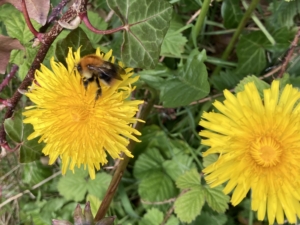
When you get the urge to mow or to dig up weeds – stop and let them grow – received wisdom from gardening experts. But what defines a weed? The RHS tells us that Taxonomically, the term, has no botanical significance because a plant that is a weed in one context is not a weed when growing in a situation where it is wanted -such plants being known as beneficial to nature and wildlife. A weed is a flower growing in the wrong place, observed the American scientist.
George Carver Washington in the early 20th Century. Born a slave he became an eminent botanist, devoting his life to sustainable farming alongside wild plants. Whilst the author who brought us Winnie the Pooh, AA Milne, noted in an article on Gardening. Weeds are flowers too once you get to know them. Perhaps the most popularof weeds is the dandelion, which with white clover is mown out of lawns, along with their food value for insects and birds. Another plant generally considered to be a weed is coltsfoot – anyone who has walked around
Bowdon churchyard in the last few weeks would have seen this growing in golden abundance – an example of how a plant normally consigned to the compost heap has given us a flowering carpet of gold beloved of bees. Weeds are flowers too – once you get to know them. Perhaps we should learn about each plant, stop, and take some thought before we condemn them.
Written by Vivienne Plummer.
Note: You will notice that there was enough rain early in the growing season to allow the grass in the churchyard to grow up. However, we operate a policy of no-mow until September to allow wildflowers (aka weeds) to flourish and drop their seeds. When autumn comes we will be strimming one area of the churchyard, but leaving the rest for wildlife.
JULY- AS BUSY AS A BEE
We continue our exploration of bees in history and literature from where we left off in Chaucer’s CanterburyTales (1346) with the first literary allusion to the saying ‘As Busy as a Bee’, and travel to present-day Manchester. The website ‘All about Manchester’s Bee emblem’ recounts:
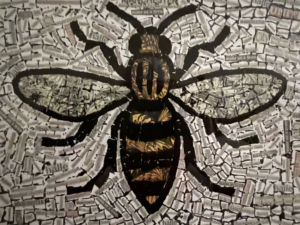
‘There are bees all over Manchester, swarms of those sweetest and busiest of insects are everwhere – even in the depths of winter they are seen on every bollard and bench….on buildings and bins all over the city’.
The worker bee is the symbol of Manchester. In 1842 the city fathers had to decide on a coat of arms that would tell the world who they were – in effect a Victorian branding exercise which was to include a globe illustrated with 7 worker bees showing to the world how Manchester industry traded across the seven seas.
Whilst the workers in Manchester’s factories toiled and lived in unhealthy and cramped conditions such as described by Dickens, with the birth of the railway their owners were able to erect grand dwellings in leafy suburbs like Bowdon. Many of them would have attended services at St Mary’s or Bowdon Downs church and their graves are recorded in our church archives.
As the worker bee of Manchester was born out of industry, so the buzzing of the busy
worker bees in our churchyard reminds us of the efforts of the Friends of Bowdon Churchyard, who through their industry have helped make the churchyard a place of natural beauty for us to enjoy.
Written by Vivienne Plummer.
JUNE – ATTENBOROUGHCULUS
‘Sir David Attenborough’s GIFT TO THE WORLD has been a life spent revealing EARTH’S WONDERS TO US ALL’
These introductory words were spoken by Kirsty Young in BBC’s 100th Birthday Celebration programme in honour of Sir David Attenborough. It’s said one shouldn’t meet one’s heroes face-to-face for fear they might disappoint, a comment completely disproved when I met Sir David in a New York hotel many years ago. He was promoting his Living World programmes, whilst I was on a public relations trip with cast members of Granada’s The Jewel in the Crown.
That evening, in spite of a tiring day, Sir David joined us for drinks and was as delightful and courteous as his TV persona – whilst also displaying a remarkable sense of humour. This was again displayed in the celebratory programme when he graciously accepted as a 100th Birthday gift a wasp – a tiny insect of 3.5mm – to bear his name as Attenboroughnculus.
FOBCY can’t begin to emulate Sir David’s achievements over the decades in bringing to our TVs the wonders of the natural world – who can forget him sitting down in Borneo with a giant gorilla?!! His documentaries have latterly focused on what we can do to help protect the world for every living creature. Yet perhaps if we remember FOBCY’s aims we can in the three acres of our churchyard take care in a little way of our local wildlife.
As a small boy in his birthday message to Sir David commented
‘I cannot do the great things of the world, but I can do little things to help care for nature around my own home’ echoing Mother Teresa’s words ‘We may not be able to do great world-wide actions but we can do the little things in our own community or street – and do them well’
Many Happy Returns Sir David and Thank you.
Written by Vivienne Plummer.
MAY – THE TENACITY OF NATURE
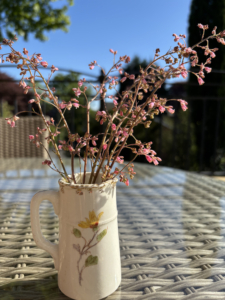
Last month we heard the back story of the Easter lily and its relevance to Christians at Easter, with its pure radiance and whiteness representing the risen Christ bringing us from darkness into light. Today we consider another plant to add to our Easter flowers list – the saxifraga x urbium – a plant which grows in urban places often flourishing on rocky ground – sometimes referred to as ‘The Stone plant’
We know it by a more common name today, ‘London Pride’, which was adopted by the residents of London in its honour after the Blitz on London in World War Two. Amongst the devastation and ruin arose this small and undistinguished plant covering the rubble with its glossy green leaves and fronds of tiny mauve flowers. Its resurrection from the devastation and darkness into the post war light of London was a symbol of resilience and tenacity. I have not been able to find ‘London Pride’ in our Churchyard though I did find some plants in a Bowdon Garden.
Post war, Noel Coward waiting for a train at Paddington Station in London records how he watched all the ‘brave and valiant’ inhabitants going about their business and daily lives amidst the ruin of their City – which is where he wrote this poem:
‘London Pride has been handed down to us
London Pride is a flower that is free
London Pride means our own dear to town to us
And our Pride it will always be’.
Written by Vivienne Plummer.
APRIL – EASTER LILIES (LILIACIA)
Like those who have been laid to rest in our churchyard whose ‘back stories’ are written up so wonderfully by our researcher Ann, so too do the plants, flowers, and trees deserve their back stories to be heard.
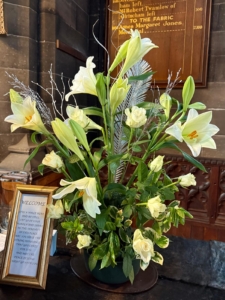
‘Nature is painting for us, day after day, pictures of infinite beauty’ wrote John Ruskin to which I would add … ‘and amazing histories’. In Christianity the lily, with its pure whiteness, represents the light of Christ’s Resurrection from Darkness to Life. The lily longiflorum (native to Japan and Tawain & introduced to Britain in the early 1850’s by Victorian plant-hunters) is the lily most used nowadays for our floral Easter displays.
But the candidum lily, which appeared in Minoan Crete in 3000 BCE, associated with motherhood and medicine, was adopted by Christianity and became known as the Madonna Lily – due mostly to painters of the Renaissance and Victorian period portraying the Virgin Mary (particularly in Annunciation paintings) surrounded by its blooms.
In her book In Your Garden Vita Sackville-West appears to have had trouble growing them as she writes about her garden at Sissinghurst Castle in Kent of her desire to get candidum lilies established:
‘I can imagine nothing which would give me greater pleasure than to see a group of
lilium candidum increasing season after season…but all my efforts have come to no avail’. Written in 1951 she would rejoice that years later when I visited her White Garden in the1980s her wish had been granted.
I am taking heart from this and am going to attempt growing some lilium candidum in tubs. If successful, I will transfer the tubs to the base of the statue of the Virgin Mary in the alcove of the south wall of our church – where in John Ruskin’s words we can ‘Day after day admire their infinite beauty’ … and their ancient back story.
Vivienne Plummer. Photo by Christine Weekes.
MARCH – THE TENACITY AND HOPE OF NATURE
ATTENTION, SILENCE ET ECOUTEZ LES FLEURS’ (Be attentive, keep silent and listen to the flowers). This is the invitation which greets worshippers at Taizé railway station before they enter the ecumenical community in Burgandy, France, one of the most important sites of Christian unity. It is an invitation which can be expanded not just to ‘listen’ but in humility also to learn from nature with its tenacity to overcome the harshest of conditions. A tenacity which gives hope.
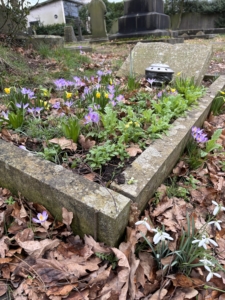
In this season of Lent when church interiors are somewhat bare, with flowers stripped away and frontals dark purple, we perhaps find hope less easy to perceive. Our churchyard might look as if it is in alliance with the interior of the church – but if we look closely we can see signs of hope breaking through winter’s soil. The daffodils, which in the Language of Flowers embody hope and which were planted last year in remembrance of loved ones, are pushing through with buds ready to open. Crocuses are already in bloom and the birds are seeking out our nesting boxes. The tenacity of nature, the hope of life, is there for us all to see.
We need to escape to places of nature and peace, away from the constant bombardment from media images of a world which seems to be tearing itself apart. In my TV career in Public Relations I recall that often reporters were sent out to seek the ‘gloom and doom’ stories rather than the ‘hope of life’ events.
Once it wasn’t considered fashionable to ‘talk to the flowers’ – our King when Prince of Wales was 50 years ahead of his time; he continues to encourage us to realise our dependence on nature to find solace and quietness. Here in Bowdon, thanks to the hard work of members of FOBCY, we too are striving to find a place where all can find harmony with nature and ‘listen to the flowers’.
Written by Vivienne Plummer.
FEBRUARY – SPACE TO BREATHE
‘We all need space: unless we have it we cannot reach that sense of tranquillity which we all require.’ Octavia Hill (1836 – 1912)
Octavia Hill was a founder member of The National Trust and fought for country graveyards and other spaces to be opened up for the inhabitants of England’s industrial cities to escape from the pollution of their daily environments. For her own health she left London for the country town of Crockham in Kent and her will decreed that she should not be buried in Westminster Abbey but ‘Under the Yew Trees in the pure earth and clean air under the blue sky of Holy Trinity Church Crockham.’
Over a century later we still have a great need of ‘escape’ to green spaces, from the endless rush of our lives, the constant shrillness of modern technology and the demands of mobile phones. Some GP practices even issue ‘Green prescriptions’ rather than medication. These needs are addressed in the Millenium book ‘Sacred Gardens’ in which the then Prince of Wales King Charles suggests that like the Victorians we too might commit ourselves in creating special areas for space and quietness. And some may find such quietness in places of Faith.
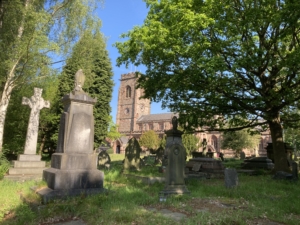
Cemeteries and churchyards have taken on a new dimension, one of welcoming visitors into a sacred burial ground which is managed and cared for as much for life as for its departed. In Bowdon we are much blessed with wide spaces in our church grounds, with their natural beauty and the ever-changing landscape of the seasons. It provides a place to retreat to for a moment or two away from the troubles of the world amidst generations of worshippers who have gone before and whose ancient memorial tablets hug the Church in which they once worshipped.
Friends of Bowdon Churchyard (FOBCY) invite you into our green spaces of quietness and reflection.
Written by Vivienne Plummer.
JANUARY – GOD’S ACRE
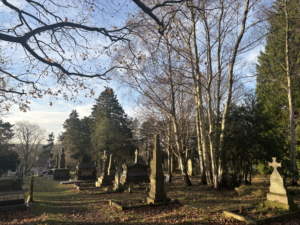
GOD’S ACRE is the name given to churchyards prior to the 19th Century. Though rarely used today its name has been relaunched by the God’s Acre Project, a national UK organisation which ‘recognises churchyards as significant areas for flora, fauna and social history’. The Friends of Bowdon Churchyard accordingly aspire to nurture our own churchyard.
During Christmas words from Christina Rossetti’s poem ‘In the Bleak Midwinter’ were sung:
‘Frosty winds made moan. Earth stood hard as iron, water like a stone’ – Indeed the ‘frosty winds did moan’ around our church building – often creeping inside! Whilst in the churchyard the earth often felt as’ hard as iron’ making working in the garden area difficult.
There often is a feeling of ‘bleakness’ once the Christmas carols are over and the decorations are down. Outside our churchyard may also look ‘bleak’. However as Stefan Buczacki reminds us in his book ‘Earth to Earth: a Natural History of Churchyards’ there is neverthless life in abundance there. He suggests we take a walk around to look for ‘fungi, lichen, wild plants and berries, all alive and contributing to the ecological yearly cycle of life’. I took such a walk last week and discovered how right he was. Even the mush of the slippery fallen leaves plays its part, covering and protecting our bulbs and life to come in the spring. And he has a warning to those who tend our churchyards not to ‘over manicure’ them in the winter months but to ‘let them be’ for they give shelter and food for wildlife – and hope for life to come.
Written by Vivienne Plummer.
DECEMBER – THE TREE OF LIFE
Though we are just into the season of Advent in the Church’s year, a season of prayer and reflection, it seems that the world in its rush towards Christmas is already in a frenzy of busyness. The Christmas tree has been chosen and sits with its’ glittering lights and ornaments in our homes. Sadly though with its transitory life the Christmas tree will end up in January a sore sight of bare branches awaiting collection outside our homes.
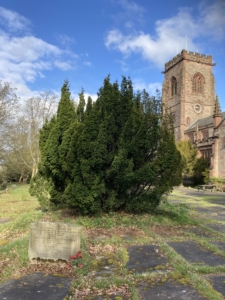
Yew trees (taxus baccata), on the other hand, are ancient and mystical trees which have been around since the Jurassic period. In the Bible the yew tree is primarily associated with the concept of everlasting life with its ability to renew itself, even if cut down, and as a symbol of endurance. Christianity has adopted the yew as symbolising nature’s renewal in the circle of life through birth, life, death & resurrection.
The oldest yew recorded in the UK, at between 2 – 3000 years old, is the Fortingall yew in Perthshire, Scotland. The Ankerwy yew in Berkshire is thought to have been witness to the signing of the Magna Carta in 1215 and also served as a meeting place between Henry VIII and Anne Boleyn in the 1530s. The yew has been used for many purposes over its history – in medieval times its wood was used for arrows whilst today its foliage is used as a base for cancer treatment.
For hundreds of years the yew has been a familiar sight in our churchyards – planted for protection, before churchyards were enclosed by walls, where they watched over those who had gone before. The poison of their foliage and berries kept cattle and other animals at bay and prevented their desecration of graves. And in the past the foliage of the yew was often carried by mourners at funerals to represent everlasting life.
Written by Vivienne Plummer.
NOVEMBER – FOR THE FALLEN.
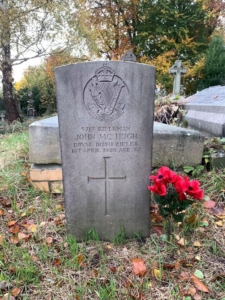
Words which will be spoken at places of Remembrance in the following days as we remember those who gave their lives in the 1st & 2nd World Wars – and subsequent conflicts. On Sunday November 9th those words will echo out as we stand by St Mary’s Church alongside its War Memorial where wreaths of poppies – the universal flower of Remembrance – will be laid.
Another flower, the daffodil which is associated with Hope, in its bulb form was distributed for All Souls last Sunday to those who wished to plant them in the Church Yard in memory of loved ones, and where in the words of William Wordsworth they will in the spring bloom ‘a host of golden Daffodils’, giving us a vision of Hope.
Our Churchyard is a place of natural beauty and quiet retreat, a space to reflect and remember on its’ many memorial seats. Possibly the best for a panoramic view is a bench in the recess of the church’s south wall behind a memorial stone to Jean Taylor, author of 15 books on floral artistry. Jean’s memorial was placed in the 1980s by the Mary Guild in recognition of her writings and teaching. As we look out over Jean’s memorial perhaps we could reflect on words from the poem ‘Leisure’ by W Davies: ‘What is this life if full of care we have no time to stop and stare?’ Bowdon Church Yard is the perfect place to ‘stop and stare’ reflect and remember. A quiet space open for all and which has no membership card or entry fee! COME AND SEE.
Written by Vivienne Plummer