
A History of the Parish of Bowdon and its Community
The churchyard of St Mary’s the Virgin contains graves dating back to the 17th century. This makes it a wonderful source of historical information about Bowdon and the surrounding area, with graves of many of the families that have lived and worked in the area.
The churchyard was extended in 1815, 1859, and finally in 1876 down to Langham Road. It is a peaceful site with some fine Victorian monuments set among the trees. A large yew tree reputed to be used for the Domesday measurements was accidentally burned down and a new The WWI Memorial. tree planted on the site in 1978.
An estimated 40,000 people have been buried here over the ages. There are approximately 5,000 grave sites and eleven war graves, four of them with War Grave Commission headstones with the others in family graves. At the east of the church is an area for local vicars who played their part in shaping the fabric and society of the area.
In particular, the imposing tomb of Archdeacon William Pollock can be seen. He was the driving force behind the building of the new church and an elaborate vicarage on Park Road, Bowdon. His successor in 1873 Rev. Canon Arthur Gore, had St Luke’s Mission Church built in Bowdon Vale. The northern custom before Victorian times was to have flat gravestones. The rebuilding of the church in 1858-60 led to the re-siting of some of the oldest ones around the church, so they are no longer over the original graves.
The oldest known grave is found on a long thin stone, five gravestones out south of the Stamford Chapel. It is that of William Artinstall de Ringey (Ringway), dated 1617. One of the many interesting graves belongs to Bowdon resident William Wood (d.1868). He is known as ‘the Chimney Boys’ Friend’ and is famous for pushing through legislation to prevent children from climbing up chimneys and cleaning them, despite mechanical alternatives. His coffin was carried to his grave by six sweeps from five different towns. There is also a memorial to local man Nick Estcourt, the mountaineer, who was lost on K2 in 1978
We plan to provide information to support school projects so that our young people can discover more about those that have gone before and how they contributed to the community within which they live.
For example there are many significant war graves of those who gave their lives in many different conflicts, and about who we are able to provide interesting information.
We also plan to provide information within the churchyard itself to create a walking tour through the history of our community.
Grave Tales
Image Archive
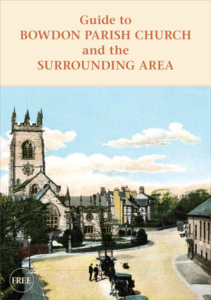
Guide To Bowdon Parish Church And The Surrounding Area
The long ridge of Bowdon Hill is crossed by the Roman road of Watling Street, now forming some of the A56 which links Cheshire and Lancashire. Just off this route in the raised centre of Bowdon, a landmark church seen from many miles around has stood since Saxon times.
In 669, Church reformer Archbishop Theodore divided the region of Mercia into dioceses and created parishes. It is likely that Bowdon was one of the first, with a small community here since at least the 7th century. The 1086 Domesday Book tells us that at the time a mill, church and parish priest were at Bogedone (bow-shaped ‘dun’ or hill). It was held by a Norman officer, the first Hamon de Massey. The church was rebuilt in stone around 1100 in Norman style then again in around 1320 during the reign of Edward II, when a tower was added, along with a new nave and a south aisle. The old church became in part the north aisle. In 1510 at the time of Henry VIII it was partially rebuilt, but the work was not completed.
Click on the icon to access this wonderful publication